I was thirty-two years old, sitting in a conference room on the fourteenth floor of an office building in downtown Houston, when something broke in me that couldn’t be repaired.
The CEO was mid-sentence, explaining why we needed to “recommit to our people” and “rebuild trust with our workforce.” He used the word “family” three times in as many minutes. Everyone nodded. Someone took notes. The presentation was polished.
Three hours earlier, that same CEO had been in a different conference room, walking through spreadsheets showing how we’d restructure pension obligations to improve quarterly numbers. The projections were clean. The math worked. Thousands of people who’d spent decades with the company would retire with less than they’d been promised. But the shareholder value would stabilize.
Nobody mentioned this in the afternoon meeting. Nobody needed to.
I sat there watching him speak about commitment and family, and I understood something I’d been feeling but couldn’t name: the system wasn’t broken. It was working exactly as designed. It just wasn’t designed to do what it said it was doing.
That gap—between what systems promise and what they actually deliver—became the thing I couldn’t stop seeing. And once you see it, you can’t unsee it.
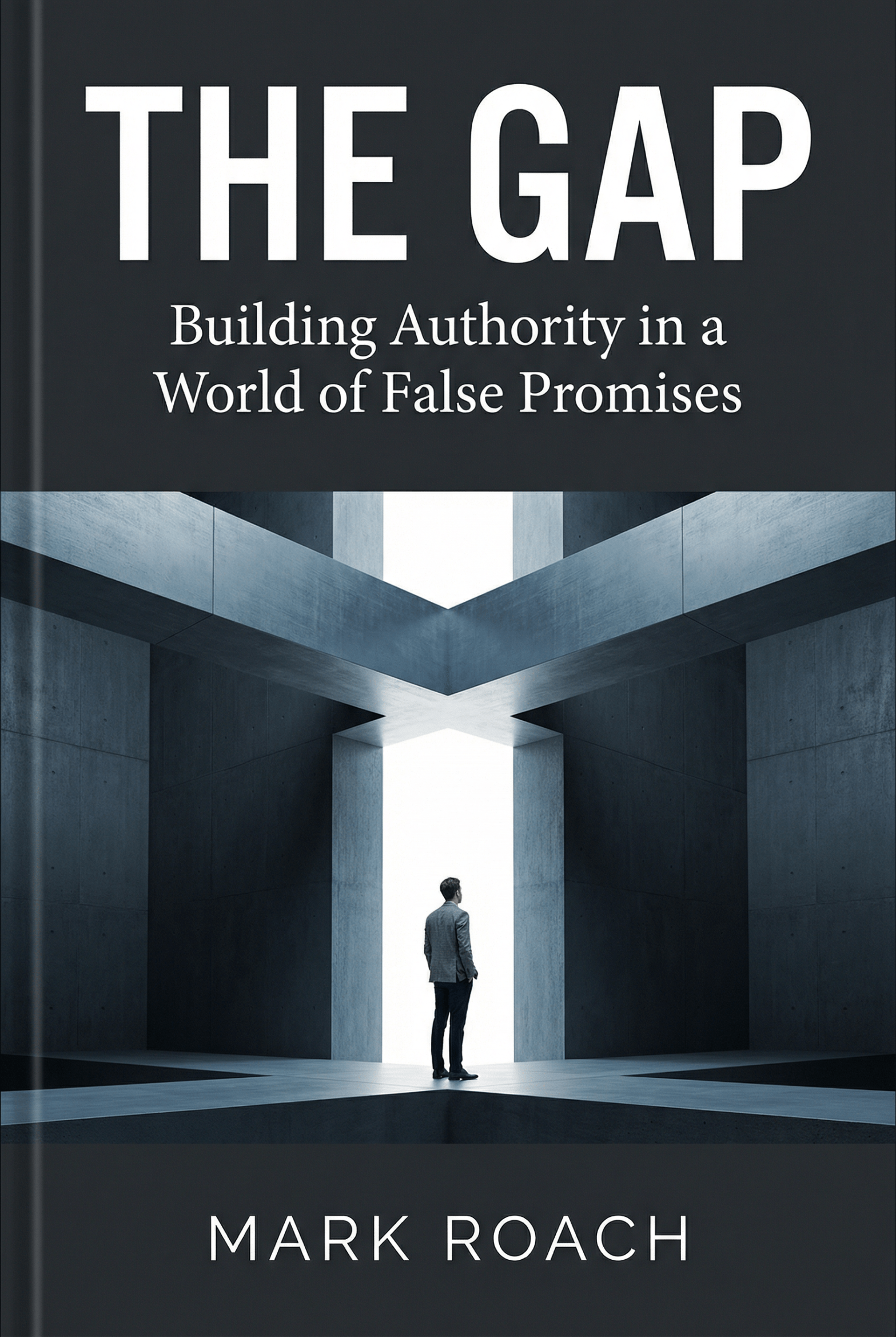
This is what my new book, “The Gap: Building Authority in a World of False Promises,” explores. Not as theory. Not as a solution. But as the lived experience of what happens when you stop waiting for systems to deliver what they promised and start seeing what’s actually here.
You’ve Already Felt This
You know the promises. You’ve heard them your entire life. They’re woven into everything you’ve been taught about how the world works.
Work hard and you’ll have security. Follow the rules, do what’s expected, conform to what’s required, and you’ll be protected. The system will take care of you.
Achieve the milestones and you’ll be happy. Get the degree, the job, the promotion, the title, the salary, the house. Accumulate the markers of success and you’ll feel good about your life.
Keep climbing and you’ll reach satisfaction. There’s a point where you’ll feel complete. Where you’ll know you’ve arrived. Where you can rest in the knowledge that you did it right.
Fit in and you’ll belong. Conform, think the right things, say the right things, and you’ll be included. You’ll be part of something meaningful.
Maybe you’ve done some version of this. Maybe you’ve done all of it. You got the degree. You got the job. You got promoted. You increased your salary. You achieved things people told you were impressive.
And maybe you’ve had the experience of getting exactly what you thought you wanted and discovering it didn’t feel the way you expected.
The promotion came with more pressure, more hours, more performance anxiety. The achievement came with the immediate awareness of the next thing you’re supposed to want. The belonging required suppressing the part of yourself that sees clearly.
You weren’t happier. You were just more invested. More dependent on the next milestone to prove that this path was working. More trapped in the logic that says fulfillment is always one achievement away.
If you’re reading this and you recognize yourself in these words, you’re not broken. You’re not ungrateful. You’re not failing to understand “the bigger picture.”
You’re seeing clearly in a system that requires you not to.
What This Book Actually Is
“The Gap” is not a self-help manual. It won’t give you seven steps to freedom or teach you how to hack the system. It won’t promise you transformation, awakening, or liberation through any particular method.
This book is an observation. A naming of patterns. An invitation to see clearly what’s actually happening beneath the surface of what systems claim to be doing.
It’s grounded in twenty years of lived experience inside systems that promised one thing and delivered another. Oil and gas companies that talked about sustainability while their entire business model required extraction. Financial firms that celebrated client wealth while engineering products designed to extract fees. Corporate structures that promised growth while creating conditions that made people smaller, more afraid, more compliant.
I didn’t study these systems from the outside. I worked inside them. I participated in them. I was rewarded by them. I watched them operate from positions where I could see both what they said publicly and what they actually did structurally.
And I came to understand that the gap between those two things—between what systems promise and what they deliver—isn’t dysfunction. It’s design.
The Journey Through the Book
The book moves through ten chapters that trace a path from recognition to clarity to what becomes possible when you stop waiting.
The early chapters name the problem. What it feels like to wake up inside a system and discover you can’t go back to not-seeing. Why systems silence what they most need to hear. How to read the actual architecture of control beneath the surface promises—the mechanisms of fear, manufactured scarcity, and narrative loops that keep people participating.
The middle chapters explore what I call infiltration. How to maintain integrity while operating inside structures that compromise it. How to use your inner life—your observations, dreams, resistance, even your shadow—as reconnaissance. What you learn from systems that you can’t learn any other way. How to recognize when your time inside a system is complete.
The later chapters move into what happens after you stop waiting. How to build authority that doesn’t depend on systems. How to relate to others as peers rather than recreating the hierarchies you just escaped. What real safety, happiness, and satisfaction actually require when you stop organizing your life around external validation.
The final chapter opens into what comes next. Your role in what I call the evolutionary guru work—being someone who made it through, who can witness and hold space for others, without positioning yourself as an authority they should follow.
This Is Not What You Think
Here’s what makes this book different from most books about systems, work, or finding meaning:
I’m not positioning myself as someone who has the answers. I’m not claiming to have transcended systems or found some higher ground. I’m someone who lived inside the contradictions long enough to see them clearly. Someone who paid attention. Someone who couldn’t stop seeing once the seeing started.
This book doesn’t promise escape. You can’t extract yourself from systems. You’re embedded in structures of economy, culture, relationship, meaning-making. The fantasy of extraction is itself one of the promises that keeps you trapped—the belief that if you just found the right path, the right practice, the right teacher, you could finally be free.
This book doesn’t tell you to leave or to stay. It explores something more nuanced: what becomes possible when you stop organizing your life around what systems promise and start building what you actually need. How to operate with integrity inside structures that don’t share your values. How to maintain clarity without being destroyed by what you see.
This book holds contradictions without resolving them. You were complicit in harm AND you were captured by systems designed to capture you. You benefited from extraction AND you recognized the cost. You learned valuable things AND the price was high. Both truths can coexist. Maturity is learning to hold them simultaneously.
Who This Book Is For
You might be someone who’s spent ten or twenty years climbing the ladder and finally realized the ladder is against the wrong wall. Someone who followed all the rules and discovered that obedience delivered dependence, not safety. Someone who achieved everything you were supposed to achieve and still feels empty.
You might be someone who’s starting to see the contradictions—between what your company says and what it does, between what you value and what you’re asked to participate in, between the person you thought you’d become and the person you’re being asked to be.
You might be someone who’s been performing alignment you don’t feel, suppressing clarity to maintain belonging, wondering if you’re the only one who sees that none of this makes sense.
You’re not alone. Millions of people feel this gap. They sense the dissonance between what they’re told and what they experience. But the system gives them no language for it. No framework. No permission to name what they’re seeing without being labeled as the problem.
This book gives you that language.
What Becomes Possible
Here’s what I’ve come to understand: the moment you recognize that the system will never give you what it promises—not intellectually, but in your body, in your lived experience—something shifts.
You stop organizing your life around the promise.
You stop measuring your worth by the system’s approval.
You stop waiting for belonging, safety, happiness, satisfaction to arrive from outside you.
You stop performing alignment you don’t feel.
You stop suppressing what you see to maintain conditional inclusion.
And in that space—the space where you’re no longer waiting, no longer performing, no longer measuring yourself by promises the system will never keep—you discover something else.
Clarity. Authority. The capacity to navigate reality as it actually is, not as you’ve been told it should be. The ability to make decisions based on what’s true rather than what’s required. The freedom to see clearly and act from that seeing.
This is not freedom from the system. You still live in it. You still have to relate to it. You still have constraints, obligations, responsibilities.
But it’s freedom within the system. The freedom to see without needing to escape. The freedom to understand without needing to fix. The freedom to participate without being captured.
An Invitation, Not a Prescription
“The Gap” releases because something real is happening that nobody talks about clearly. You’ve probably already felt it. You’ve probably already seen it. You just didn’t know anyone else was seeing it too.
This book is my attempt to name what I saw. To offer the observations I gathered from twenty years inside systems that operate one way while claiming to operate another. To validate what you’re already experiencing and give you a framework for understanding it.
I’m not asking you to believe me. I’m not asking you to follow a method. I’m not promising that reading this book will solve anything.
I’m just saying: if you’ve been feeling the gap between what you were promised and what you’re actually experiencing, you’re not crazy. The gap is real. The contradiction is structural. And seeing it clearly is not the end of something.
It’s the beginning.
“The Gap: Building Authority in a World of False Promises” is available now. You can learn more at roachcreative.com.
If these words landed for you—if you recognized yourself in them—I’d be grateful if you shared this with someone who might need to read it. Not because I’m building a platform or looking for followers, but because people who are waking up inside systems need to know they’re not alone.
That recognition matters. It’s where everything begins.

 RoachCreative