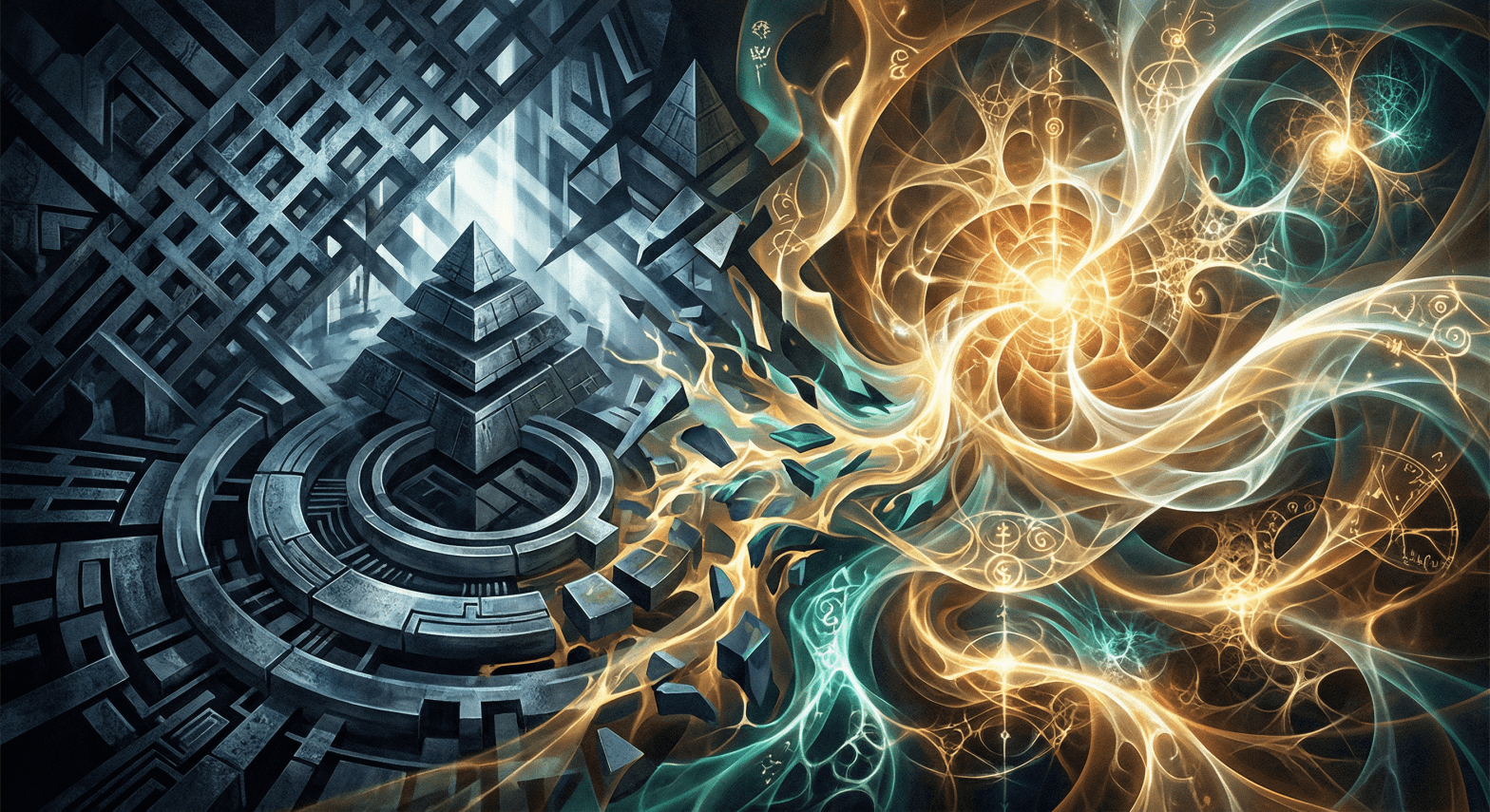
The electricity is fading from your life. You feel it, even if you can’t name it yet.
Things that used to work—the systems you were told to trust, the institutions that promised security, the expertise you were assured would lead somewhere—are all revealing themselves to be constructed on an architecture that wasn’t designed for you. It was designed for something else entirely. Something that requires your obedience more than your flourishing.
This isn’t paranoia. This is clarity. And clarity, as disturbing as it can be, is the first step toward actual power.
We live in a peculiar moment in human history. We have more information than any generation before us, yet we feel less certain. We have more connection than ever, yet we feel more isolated. We’ve achieved unprecedented material comfort in many corners of the world, yet anxiety has reached epidemic proportions. Something in the architecture is broken. Or perhaps it’s working exactly as designed—which might be the more unsettling truth.
The First Betrayal: Inspiration Isn’t Permanent
The moment you need to understand this: humans are not designed to operate at peak capacity continuously. You’re built for episodic brilliance, not constant performance.
But the culture you’re embedded in—the systems you navigate daily—doesn’t acknowledge this. It demands that your peak states be permanent. It wants your best work delivered on schedule, every single day, regardless of your actual capacity. This isn’t just exhausting. It’s architecturally impossible.
The ancient mystics understood something that modern psychology is only now rediscovering. They recognized that authentic connection to something larger than yourself is episodic. It arrives as grace, not as achievement. The moment you try to own it, the moment you shift from being absorbed in the experience to observing yourself in it, the connection shatters.
Psychologist Mihaly Csikszentmihalyi documented this in his research on flow states and peak experience. These moments demand radical self-forgetfulness. The separate sense of self must evaporate. The moment the ego re-engages to claim or observe the experience, the flow stops.
Here’s what this means for you: You are not supposed to be consistently brilliant. You’re meant to be a channel, not a reservoir. The moment you calcify—the moment you try to own the inspiration or claim authority over its source—you become blocked. The flow stops.
But the systems surrounding you don’t care about this truth. Your employer doesn’t care. The performance metrics don’t care. The culture of constant optimization doesn’t care. They demand you be permanently switched on, permanently producing, permanently performing at the level of your best moments.
This impossible demand creates a specific kind of suffering. It’s not the suffering of working hard toward something meaningful. It’s the suffering of working hard to maintain a false version of yourself. And this suffering isn’t a sign you need to try harder. It’s a sign that the entire operating system is fundamentally misaligned with how humans actually work.
The Second Betrayal: Force Has Been Rebranded as Power
We need to establish something essential right now: there is a profound difference between Force and Power, and understanding this distinction will determine everything about your life moving forward.
Power emerges from integrity, truth, and internal alignment. It’s sustainable. It supports life. When you’re operating from power, you’re not exhausting your reserves because you’re drawing from something deeper than personal ambition.
Force is driven by ego and the need for external control. It’s self-defeating because it requires constant energy consumption to maintain its grip. It destroys what it attempts to control. Force always fails eventually because it’s fighting against the fundamental nature of reality itself.
There’s a measurable difference between these states. Consciousness researchers have documented that Power creates coherence—things align, support develops, outcomes flow more naturally. Force creates friction—everything becomes harder, resistance increases, energy gets consumed just maintaining the illusion of control.
But here’s where it gets more disturbing: Reason itself can become a weapon. We’re taught that reason is the highest form of thinking, and in many ways it is. But reason divorced from intuitive knowing becomes a prison. In our modern age, reason has been weaponized by institutions as “objective truth” to demand compliance rather than genuine discernment. We’ve replaced internal power with institutional force, then called it objective science.
Think about your own life. How many decisions do you make based on internal knowing versus based on what some authority told you was true? How often do you trust your own intuition versus trusting “the experts”? And when you choose the experts, how often is that choice actually free, or have you been conditioned to experience expert consensus as truth itself?
This is the trap that catches almost everyone: Force disguises itself as Power. Institutions present themselves as sources of external authority when they’re actually mechanisms of external control. And you’ve been trained from childhood to believe that surrendering your internal authority to external institutions is not just normal—it’s the mark of being civilized and educated and responsible.
The systems want you to mistake force for power because a population operating from external dependency is far easier to manage than a population operating from internal authority.
The Third Betrayal: Your Pain Has Been Classified
This is where it becomes deeply personal, and this is why clarity can be so disturbing.
Throughout history, oppressive systems have maintained themselves by developing ethical frameworks that rationalize domination. A psychological mechanism called “moral licensing” allows people to believe they’re acting for a “higher good” while committing harm. When the framework is established, when it’s made to seem objective and righteous, the people operating within it can cause tremendous damage while maintaining the conviction that they’re acting morally.
This wasn’t limited to historical atrocities. This is how systems maintain themselves in the present moment. They develop ethical frameworks—efficiency, progress, development, evidence-based practice, market forces—then they weaponize these frameworks to justify extraction. And because the framework is supposedly objective and scientific, dissent becomes not just wrong but irrational.
Here’s how it works in your life specifically: Your pain, your questions, your sense that something is deeply misaligned—these have been classified as personal problems. Burnout? You’re not resilient enough. Depression? You have a chemical imbalance. Existential exhaustion from working within systems that feel spiritually hollow? You need better productivity tools. The system translates your legitimate signal that something is wrong into evidence that you are broken.
This is brilliant architecture because it prevents you from recognizing what’s actually happening: the system itself is extracting from you unsustainably. Your pain isn’t a sign that you’re inadequate. Your pain is precisely calibrated data that the current operating system is not designed for human flourishing.
The moment you accept the system’s classification of your pain as personal failure, you stop looking at the system itself. You start trying to fix yourself to fit into a structure that was never designed to support what you actually need.
The Fourth Betrayal: You’ve Been Taught to Surrender Your Own Knowing
This is the deepest one, and it’s where the real control lives.
You were born with internal authority. An infant knows when it’s hungry. A child knows when something feels wrong. This direct knowing—this capacity to sense truth in your own nervous system—is the only reliable navigation system humans possess.
But you’ve been systematically trained to distrust this knowing in favor of external expertise. You’ve learned that your body’s signals are unreliable. That your intuition is just emotion. That your felt sense of things is subjective and therefore worthless. The only valid knowledge comes from external sources: credentials, data, institutions, people with authority.
This creates a specific vulnerability. It makes you dependent on external validation for knowledge you actually possess internally. You’ve been trained to ask permission from authorities before trusting your own experience.
Think about the last time you knew something was wrong with a situation—a job, a relationship, a system—but you dismissed your knowing because there wasn’t external evidence yet. Think about how many times you’ve overridden your own sense of things because someone with credentials told you to. Think about how often you feel confused not because the situation is genuinely confusing but because your internal knowing contradicts what external authorities are telling you to believe.
This is the trap. The systems cannot function if populations operate from their own internal authority. They require people that have learned to distrust themselves and default to external authority instead. This isn’t a secret conspiracy—it’s just how hierarchical control systems work. They must colonize your internal knowing to maintain control.
But here’s what becomes available when you reclaim it: you immediately recognize the difference between true power and force dressed up as truth. Your body knows. Not your thinking mind—your nervous system. Your system calibrates truth and falsehood with perfect accuracy. The moment something is based in force rather than power, your system registers it as wrong.
The problem is you’ve learned to override that signal. You’ve learned to rationalize away your own knowing because actually trusting yourself and acting on that trust feels dangerous. And it is—dangerous to the systems that depend on your compliance.
The Fifth Truth: The Rebranding of Humility
Here’s what’s actually happening in this moment: The old certainties are failing simultaneously.
The institutions that promised security are revealing themselves to be vehicles for extraction rather than care. The expertise you were trained to defer to is increasingly transparent as force rather than power. The ethical frameworks used to justify these systems are becoming visible, and their contradictions are becoming undeniable.
This creates a specific opening. When the old maps stop working, when the institutions you trusted reveal their misalignment with human flourishing, something shifts. You become willing to question what you’ve been taught. You become open to different ways of understanding power itself.
But this opening only exists if you embrace what might look like chaos: intellectual humility. The willingness to not know. The capacity to question foundational assumptions. The courage to say “I was wrong about this” or “I no longer trust this” without yet knowing what comes next.
This kind of humility is terrifying because you’ve been trained to believe that certainty equals safety. You’ve been taught that not knowing is weakness. But the opposite is true. The moment you’re willing to admit what you don’t know, you become free to actually learn something real.
And this is where actual transformation becomes possible.
The Discerning Vessel: What Real Power Looks Like
There’s a concept worth understanding, one that contradicts everything the systems have taught you about power and authority.
Real power emerges not from claiming authority but from becoming transparent enough for something larger than personal ego to flow through. It’s the difference between someone who has to constantly assert their dominance and someone who doesn’t need to because their internal alignment is evident.
This is the opposite of what the systems try to create. The systems want hierarchical authority. They want leaders who claim to have it all figured out. They want gurus who project unwavering certainty. They want populations that surrender to those figures.
Real power looks different. It acknowledges the paradox: authentic transmission of truth can only happen through a permanently flawed vessel. The moment the vessel claims to be infallible or transcendent or beyond doubt, the transmission becomes corrupted. Real wisdom always arrives as the negation of ego, not as the ego’s achievement.
This changes everything about how you approach power, and it changes everything about who you should be learning from.
If someone claims to have it all figured out, you’re looking at Force, not Power. If someone presents themselves as having transcended their own humanity, you’re looking at ego dressed up as enlightenment. If someone demands your obedience or offers you certainty, you’re in the presence of control, not wisdom.
Real power arrives as permission. As recognition. As the activation of something you already possess but have been trained to doubt. A genuine teacher doesn’t make you dependent. They make you aware of your own capacities.
The Practical Shift: How to Reclaim Your Authority
So what does this actually mean for how you live, given that you’re embedded in systems designed to extract your authority?
The shift begins small and internal, then expands outward.
First, you start noticing. You pay attention to what makes you expand and what makes you contract. You recognize the difference between being in flow—aligned, capable, energy-generating—and being in forced performance—depleted, disconnected, energy-consuming. Your body knows the difference immediately. The systems train you to ignore that knowing. You start listening to it again.
Second, you begin to distinguish between legitimate authority and force pretending to be authority. A legitimate authority supports your actual flourishing. It creates capacity in you. It makes you more capable, not more dependent. Force always requires your compliance and punishes your questioning. Notice which is which. Your discernment is calibrated perfectly for this.
Third, you stop treating your own knowing as suspect. You test what feels true to you against external information, but you don’t automatically defer to the external information. You notice when they conflict and you sit with that conflict rather than resolving it prematurely by abandoning your own knowing.
Fourth, you find others who are asking similar questions. The isolation that the systems create is part of the control structure. The moment you recognize that your pain, your questions, your sense that something is misaligned are shared by others, you’re no longer alone with the systems’ classification of you as broken. You’re part of a recognition.
This doesn’t mean you immediately walk away from all systems or that you reject institutions wholesale. Some systems are aligned with human flourishing. Some institutions actually serve people. The discernment is in learning to recognize which ones and making conscious choices about your participation rather than unconscious compliance.
But it means you stop surrendering your internal authority. It means you start treating your own knowing as valid data. It means you begin to notice when a system is extracting from you unsustainably and you start making conscious choices about your relationship to it.
Why This Moment Matters
You’re living in a moment of massive transition. The old certainties are failing. The institutions that promised security are revealing their misalignment with human flourishing. The expertise you were trained to defer to is increasingly transparent as force rather than power.
This is terrifying. And it’s also the moment when actual change becomes possible.
When the maps that people have been relying on stop working, when the authorities lose their credibility, when the pain of maintaining the old system becomes greater than the fear of change—this is when humans reorganize. Not because they have it all figured out, but because they’re willing to try something different.
The architecture of power only maintains itself through your compliance. The moment enough people reclaim their internal authority—the moment enough people become transparent enough to transmit something other than force—the structure itself becomes unable to hold.
You don’t need to figure out the whole system. You don’t need to have all the answers. You just need to be willing to trust your own knowing, to notice what’s true in your own nervous system, and to find others who are doing the same.
That’s not naive. That’s revolutionary.
The moment you stop seeking permission from external authorities to be yourself is the moment actual power becomes available. Not power over others, but power with life itself. The power to align your existence with what’s actually true rather than what you’ve been told to believe.
Your pain isn’t a sign you need to try harder within the system. It’s a sign that the system needs to change. And that change begins with you reclaiming the authority you never should have surrendered.
Start small. Trust one thing your body tells you this week. Notice what makes you expand and what makes you contract. Find one person who’s asking similar questions. Begin there.
That’s how the architecture shifts.

 RoachCreative